
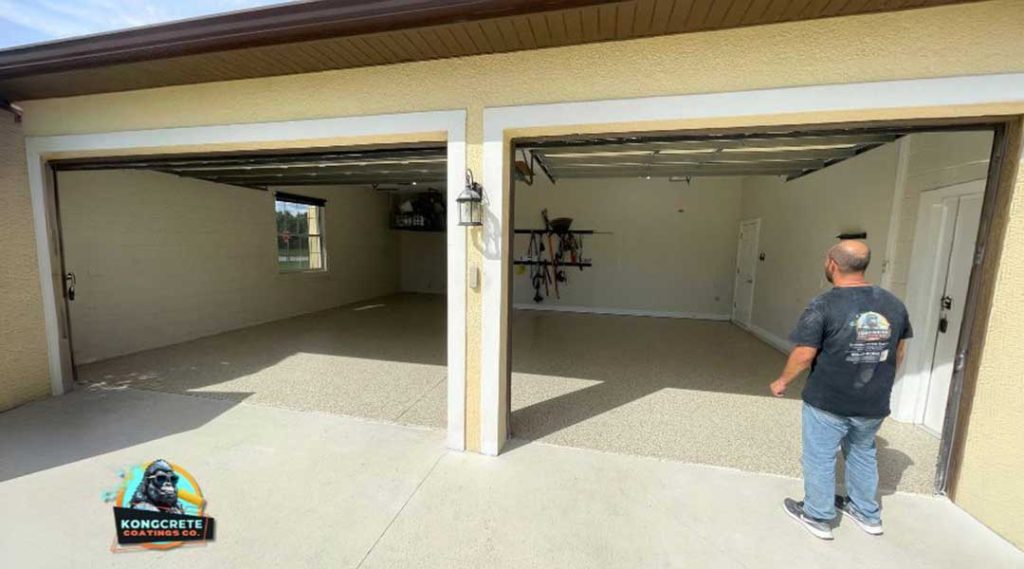
Garage floors take more abuse than most homeowners expect. Between vehicle traffic, Florida heat, humidity, and chemical exposure, coatings are constantly under stress. Epoxy flooring offers a clean, sleek finish, but hidden risks often develop beneath the surface when the wrong materials or preparation methods are used.
Many property owners searching for epoxy flooring in Orlando are surprised to learn how frequently standard systems fail under Florida conditions. Peeling, blistering, fading, and premature wear can disrupt daily routines and lead to expensive repairs that could have been avoided.
At Kongcrete Coatings, we install high-performance polyaspartic floors engineered to outperform basic garage floor epoxy systems. Understanding why traditional epoxy fails is the first step in protecting your investment long term.
Inadequate Surface Preparation Results in Peeling
Surface preparation is the foundation of any successful garage floor coating. When prep work is rushed or skipped, failure becomes almost inevitable.
Research across the coatings industry consistently shows that the majority of epoxy failures stem from improper surface preparation. Grinding, shot blasting, moisture testing, and contaminant removal are essential steps that cannot be overlooked.
Concrete naturally contains dust, oils, and embedded residues. Without mechanical preparation, these contaminants form invisible barriers between the coating and the slab. The result is weak adhesion that may look fine initially but begins peeling within months.
Hollow-sounding spots often indicate where bonding never fully occurred. Once delamination starts, entire sheets of garage floor epoxy can lift, exposing bare concrete underneath.
At Kongcrete Coatings, we follow a controlled preparation process designed specifically for Florida conditions. Proper profiling and moisture assessment ensure the coating penetrates and bonds correctly, reducing the risk of costly surprise failures.
Hot-Tire Pickup Deteriorates Standard Epoxy Coatings
Hot-tire pickup is one of the most common garage floor epoxy failures in Florida. After highway driving, vehicle tires can exceed 140°F. When parked on standard epoxy, that heat softens weaker coatings and pulls them up as tires cool.
Thermal softening: Standard epoxy formulations can soften under high tire temperatures, weakening adhesion at the surface.
Plasticizer migration: Modern tires contain plasticizers that chemically interact with low-grade epoxy, accelerating delamination.
Insufficient solids content: Many consumer-grade garage floor epoxy kits lack the resin build needed to withstand repeated thermal stress.
Surface tearing: Over time, repeated hot-tire exposure causes visible lifting or patching in parking zones.
Polyaspartic systems resist this problem because they cure harder and maintain flexibility under temperature stress. This combination prevents tire adhesion and protects the slab beneath.
UV Exposure Causes Epoxy Discoloration
Florida sunlight is relentless. Ultraviolet rays break down the chemical bonds within standard epoxy coatings, leading to yellowing, dulling, and uneven color changes.
This is especially noticeable near garage door openings where sunlight enters daily. Over time, color inconsistency becomes obvious, particularly with lighter or gray tones common in garage floor epoxy installations.
UV degradation is not cosmetic alone. As the resin structure weakens, the surface becomes more susceptible to cracking and wear.
Polyaspartic floors are formulated with UV-stable chemistry that resists yellowing and chalking. Instead of fading within a few years, these systems maintain consistent color and gloss under prolonged sun exposure.
Moisture Vapor Transmission Leads to Blistering
Moisture vapor transmission is one of the most underestimated causes of epoxy failure in Florida. Concrete slabs continuously release vapor, especially in humid climates like Orlando.
When epoxy is applied without proper moisture testing or vapor mitigation, pressure builds beneath the coating. This pressure creates blisters and bubbles that eventually rupture and peel.
Hydrostatic pressure buildup: Water vapor rising from below pushes against sealed coatings.
Blister formation: Trapped vapor creates weak spots that expand under temperature fluctuations.
Delamination risk: Once blistering begins, adhesion weakens across surrounding areas.
Expensive repairs: Recoating requires grinding down damaged sections, increasing cost and downtime.
Professional moisture testing and the use of high-performance systems reduce this risk dramatically. Polyaspartic chemistry tolerates slight moisture better than many standard epoxy products, providing additional protection.
Humidity-Induced Curing Failures in Orlando
Orlando’s subtropical humidity directly affects how garage floor epoxy cures. High ambient moisture can interfere with chemical reactions during installation.
Excess humidity often results in cloudy finishes, sticky surfaces, or incomplete curing. Lower-quality materials are especially vulnerable to these environmental factors.
These defects may not appear immediately. Weeks later, surface dulling or premature wear begins to show, requiring correction that could have been avoided with climate-appropriate materials.
Polyaspartic systems cure rapidly, typically within 2 to 3 hours, reducing the window for humidity interference. Faster cure times also minimize exposure to sudden weather changes common in Florida.
Low-Quality Epoxy Materials Accelerate Degradation
Material quality plays a major role in long-term performance. Many budget garage floor epoxy kits contain lower resin content and fewer protective additives.
Weak bond strength: Lower-grade epoxies fail to create a strong mechanical bond with concrete.
Increased air entrapment: Cheaper resins are more prone to bubbling during application.
Shortened lifespan: Some low-quality systems require replacement within a few years.
Chemical breakdown: Exposure to brake fluid, oil, and cleaners degrades inferior coatings quickly.
Reduced slip resistance: Lack of proper additives increases slip risk when wet.
High-performance polyaspartic floors provide a thicker build, greater chemical resistance, and improved surface stability, significantly extending service life.
Temperature Fluctuations Stress Epoxy Floors
Daily temperature shifts create expansion and contraction cycles in concrete. Standard epoxy coatings are rigid and struggle to accommodate these movements.
Florida garages experience extreme daytime heat followed by cooler nights. This repeated cycle weakens surface bonds over time.
Research across the coatings industry confirms that temperature fluctuations during and after installation influence long-term performance. Even moderate swings affect resin flow and cure characteristics.
Polyaspartic floors maintain flexibility while preserving hardness. This balance allows them to absorb thermal movement without cracking or separating from the slab.
Long-Term Protection with the Right System
Unexpected failures in garage floor epoxy systems often result from improper preparation, climate incompatibility, or low-quality materials. In Florida, these risks are magnified by humidity, UV exposure, and rapid temperature changes.
By choosing high-performance polyaspartic floors installed by experienced professionals, you reduce the risk of peeling, blistering, fading, and hot-tire damage. At Kongcrete Coatings, we design every system to perform under Florida’s demanding conditions.
Our garage floor coatings are backed by the HomeLife Warranty, offering long-term protection and confidence. Instead of reacting to costly failures later, you invest in a system built to prevent them from the start.
Protecting your garage floor means choosing materials and installation practices that match your environment. When done correctly, your floor remains durable, safe, and visually consistent for years to come.