When a commercial kitchen needs a new floor, appearance is only one part of the equation.
The flooring must be designed around sanitation, cleaning, moisture, traffic, chemical exposure, slip resistance, durability, and the requirements that apply to food-service environments.
For Krokem Cookies in Orlando, Florida, Kongcrete Coatings installed a commercial-grade solid-color epoxy flooring system designed specifically around the demands of their food-production environment.
The project included extensive concrete preparation, moisture mitigation, industrial epoxy, sealed perimeter transitions, a coved wall-base detail, and a slip-resistant polyaspartic topcoat using aluminum oxide additive to give it a nice orange peel effect.
The result is a seamless, durable commercial floor designed to provide Krokem Cookies with a surface that is easier to clean and maintain while supporting the operational requirements of a professional food-production space.

Commercial Kitchen Flooring Has Different Requirement
A commercial kitchen floor is exposed to conditions that ordinary residential flooring simply does not encounter.
Food production areas can experience:
- Constant foot traffic
- Water and moisture
- Food ingredients and spills
- Grease and oils
- Cleaning chemicals
- Frequent washing
- Abrasion from equipment and carts
- Temperature changes
- Wet-floor conditions
Florida food-service requirements address characteristics such as smooth, durable, easily cleanable and nonabsorbent surfaces in applicable food-establishment areas. Florida’s plan-review guidance also identifies coved baseboards in high-moisture areas such as food preparation, food storage and warewashing areas.
That is why a professional commercial kitchen flooring system should be designed as an entire system rather than simply applying a coat of epoxy over concrete.
For Krokem Cookies, Kongcrete approached the floor with that philosophy from the beginning.
Step 1: Professional Concrete Surface Preparation
The first stage of the project was mechanical surface preparation.
Kongcrete used professional diamond-grinding equipment to prepare the concrete substrate and remove surface contaminants while creating the appropriate mechanical profile for the coating system.
After grinding, the floor was carefully cleaned to remove dust and loose particles. Commercial cleaning equipment and acetone were used where appropriate to ensure the substrate was properly prepared for the subsequent coating applications.
This preparation is critical.
A commercial floor coating is only as reliable as the concrete substrate beneath it. Proper preparation helps create the mechanical profile and surface condition necessary for the coating system to bond to the concrete.
Step 2: Repairs, Perimeter Sealing and Coved Base Detail
After the concrete was prepared, Kongcrete addressed necessary patching and detailing throughout the floor.
Special attention was given to the transition between the horizontal floor and surrounding vertical surfaces.
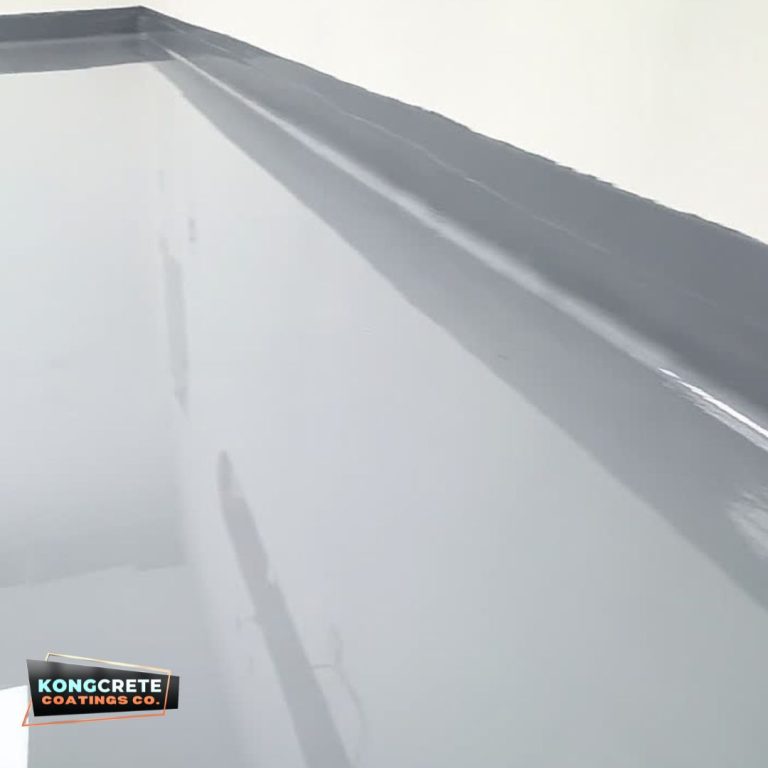
The perimeter gaps were sealed and beveled before coating, and the coating system was carried up the vertical perimeter to create a professional coved base detail.
This detail is particularly important in food-service environments because the floor-to-wall transition should be designed to remain cleanable and minimize difficult-to-clean gaps.
Florida’s food-service plan-review guidance specifically addresses coved baseboards in high-moisture food preparation, food storage, warewashing and bathroom areas.
The finished detail also gives the commercial kitchen a much more finished appearance than simply stopping the coating at the wall.
Step 3: Industrial Moisture Vapor Barrier Foundation
With the concrete prepared and detailed, Kongcrete installed the first coating layer: an industrial moisture vapor barrier (MVB).
The purpose of this layer is not simply to add another coat of material.
The MVB serves as the foundation of the flooring system and is designed to help address moisture vapor transmission from the concrete substrate while providing a strong base for the subsequent coating layers.
For projects where the selected MVB product is rated for elevated moisture vapor conditions, the manufacturer’s published moisture-mitigation rating should be used to determine the exact allowable vapor emission level. Product ratings can vary, so the technical data for the specific material—not a generic epoxy claim—should control the specification.
The MVB also provides a substantial base layer that helps create a more uniform surface for the finish system above it.

Why Moisture and the Foundation Matters in Commercial Flooring
Moisture is one of the issues that can affect coating performance when concrete is not properly evaluated and prepared.
A professional commercial flooring system should consider:
- Existing concrete condition
- Moisture vapor transmission
- Surface profile
- Contamination
- Concrete repairs
- Intended use of the space
- Selected coating chemistry
That is why Kongcrete treats the floor as a complete system rather than simply selling an epoxy coating.
Step 4. Intermediate Sanding and Thorough Clean-up with HEPA Approved Vacuums
After the initial coating stage cured, Kongcrete returned to inspect the surface and address imperfections.
Necessary areas were patched and the floor was mechanically sanded to prepare the surface for the next coating layer.
The floor was then thoroughly vacuumed using commercial HEPA filtration equipment.
Controlling dust during a commercial coating installation is important because loose dust and particles can interfere with coating adhesion and become trapped in the finished floor.
The goal is simple: clean substrate, properly prepared surface and controlled installation environment.

Step 5: Industrial Self-Leveling Epoxy Base Coat
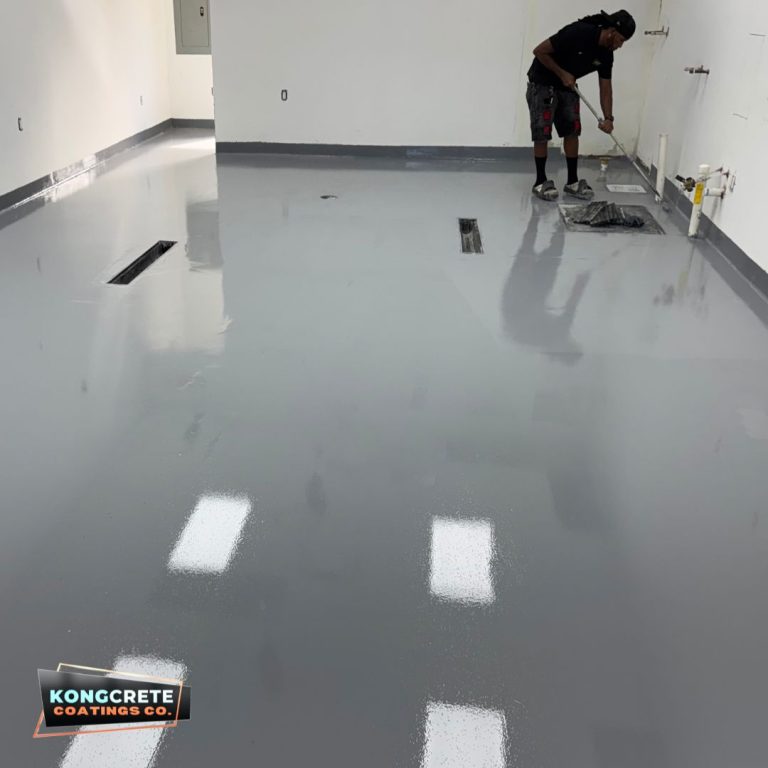
The next stage was the application of an industrial-grade self-leveling epoxy coating.
The solid-color epoxy created the primary finished base color for the commercial kitchen while providing a seamless surface without grout lines.
Modern commercial epoxy systems are commonly selected for their durability, chemical resistance, ease of cleaning and ability to create a continuous floor surface.
For Krokem Cookies, the solid-color approach was intentional.
Unlike a decorative residential flake floor, the objective here was to create a clean, professional food-service flooring system appropriate for a commercial production environment.
Step 6. Surface Preparation Between Coats
Before the final protective layer was installed, Kongcrete again mechanically prepared the surface.
Sanding between compatible coating layers can create the necessary surface profile for intercoat adhesion when required by the coating manufacturer’s specifications.
This is an important part of professional floor coating installation.
The objective is not simply to keep applying material. Each layer needs to be properly prepared for the next layer so the finished system functions as a unified flooring assembly.

Step 7: Slip-resistant Commercial Kitchen Topcoat
Because this was a commercial kitchen environment, Kongcrete selected an industrial polyaspartic topcoat incorporating a high-grade aluminum oxide slip-resistant additive.
Slip resistance becomes especially important in commercial kitchens because water, cleaning solutions, oils and other substances can create wet-floor conditions.
The goal is to balance two requirements:
Cleanability and traction.
A floor can be extremely smooth and easy to clean while still requiring additional texture for wet-area slip resistance. The appropriate traction level should be selected according to the space’s actual use and the applicable testing/specification requirements.
The exact additive and slip-resistance specification should be determined by the coating manufacturer and project requirements rather than described as an “OSHA-approved” additive. OSHA establishes workplace safety requirements, but it does not generally certify a particular aluminum oxide flooring additive as “OSHA approved.”

Why Kongcrete Does Not Use the Same Floor System for Every Commercial Project
There is no single coating system that is ideal for every commercial environment.
A professional specification should consider the conditions the floor will actually experience.
Kongcrete Coatings evaluates factors such as:
Traffic Volume
A small commercial space with limited foot traffic has different requirements than a high-volume production facility with employees, carts and equipment moving across the floor throughout the day.
Type of Traffic
Foot traffic, rolling carts, pallet jacks, equipment and other traffic can place very different demands on a floor.
Chemical Exposure
Cleaning chemicals, food ingredients, oils, grease and other substances can influence the appropriate coating chemistry and topcoat selection.
Moisture
Concrete moisture and the ongoing moisture conditions of the facility can influence the appropriate primer or moisture-mitigation system.
Slip Resistance
Wet environments may require a specific slip-resistant profile, additive or texture.
Cleaning Requirements
Food-production environments need surfaces that can be routinely cleaned and maintained without creating unnecessary areas where dirt, food particles or moisture can accumulate.
Appearance
Color, finish and design are also part of the specification. A commercial kitchen may require a practical solid-color system, while a restaurant dining area may call for a decorative flake, metallic or custom flooring design.
The right floor is therefore not simply the product with the most impressive technical specifications.
It is the system that matches the actual environment and intended use of the facility.
A Seamless Commercial Kitchen Floor Built for the Application
The Krokem Cookies project demonstrates why commercial flooring should be approached as an engineered system rather than a single product.
The completed system incorporated:
- Professional diamond-grinding and concrete preparation
- Concrete patching and surface repairs
- Perimeter gap sealing
- Coved floor-to-wall detailing
- Industrial moisture vapor barrier foundation
- Intermediate sanding and surface preparation
- HEPA vacuuming and dust control
- Industrial self-leveling epoxy
- Solid-color commercial finish
- Industrial polyaspartic protective topcoat
- Aluminum oxide slip-resistant additive
- A seamless, easy-to-clean finished surface
The result is a professional commercial kitchen epoxy flooring system designed around the specific needs of Krokem Cookies’ food-production environment.

Commercial Epoxy Floors in Orlando, Florida
Kongcrete Coatings provides commercial floor coating systems throughout Orlando and Central Florida, including commercial kitchens, restaurants, food-production facilities, retail spaces, warehouses and other demanding environments.
Our approach is simple: we do not believe every commercial floor should receive the same coating package.
We evaluate the concrete, the environment, the expected traffic, moisture conditions, chemical exposure, cleaning requirements, slip-resistance needs and desired appearance before determining the appropriate flooring system.
For businesses that need a commercial epoxy floor, seamless kitchen flooring, food-service flooring or slip-resistant commercial coating, the right system starts with proper preparation and ends with a coating package designed around how the facility actually operates.
Looking for Commercial Kitchen Flooring in Orlando?
If your business is preparing to open, renovating an existing kitchen or replacing a deteriorated commercial floor, Kongcrete Coatings can evaluate the existing concrete and recommend a commercial flooring system based on the facility’s actual requirements.
From concrete preparation and moisture mitigation to epoxy base coats, coved transitions and chemical-resistant protective topcoats, every component of the system should have a purpose.
Kongcrete Coatings — professional commercial floor coatings for Orlando and Central Florida.
