
Commercial kitchens operate in demanding, high-volume environments. Between constant foot traffic, heavy equipment, food ingredients, cleaning chemicals, extreme moisture, hot oil spills, and daily sanitation protocols, the floor needs to be more than just attractive. It must be engineered for extreme durability, cleanability, moisture mitigation, slip resistance, and the rigorous demands of a professional food-service facility.
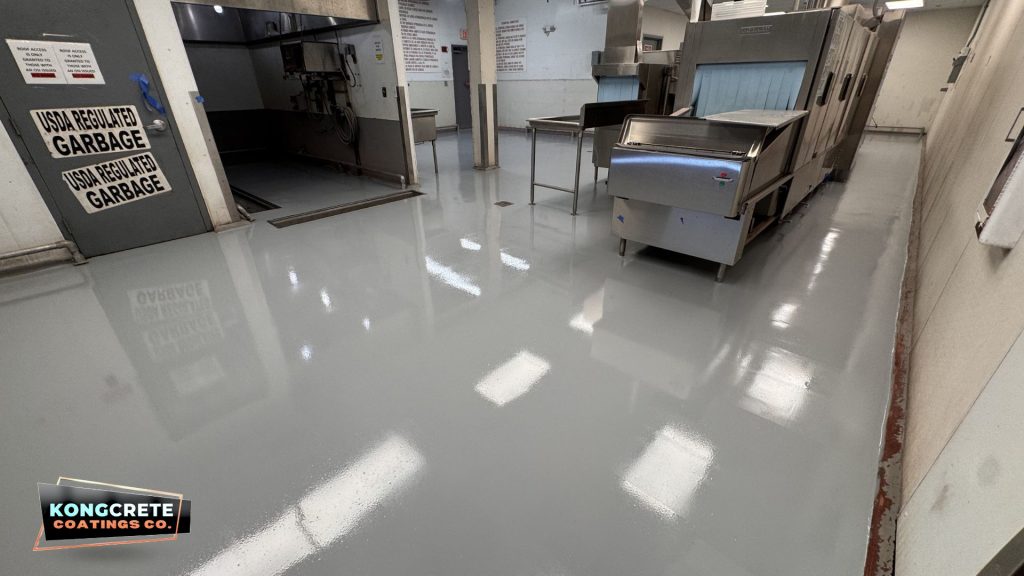
Kongcrete Coatings recently completed a commercial kitchen epoxy flooring project at Sanford Orlando International Airport in Sanford, Florida. Our team installed a professional, solid-color commercial floor coating system tailored specifically to withstand a high-use food-service environment. We service Orlando, Tampa and surrounding areas.
This project required considerably more than simply applying epoxy over concrete. We approached the installation as a complete, multi-layer commercial flooring system—beginning with mechanical substrate preparation and continuing through repairs, perimeter detailing, moisture mitigation, industrial-grade epoxy, and a high-performance protective topcoat.
Commercial Kitchen Flooring Requires the Right System
Food-service environments operate under strict safety and health guidelines. Florida’s Department of Business and Professional Regulation (DBPR) states that floors, walls, and ceilings in high-moisture areas—such as food preparation, food storage, warewashing, and bathrooms—must be smooth, nonabsorbent, in good repair, and easily cleanable, featuring integrated coved baseboards.
These regulatory standards make proper system selection and professional installation critical:
- Traffic Volume & Impact: Continuous foot traffic, food carts, and heavy cooking equipment require high tensile and compressive strength.
- Chemical & Thermal Resistance: Harsh cleaning agents, degreasers, food acids, and hot spills demand topcoats designed to prevent degradation.
- Moisture Exposure: Daily washdowns and sub-slab moisture transmission require specialized barriers and nonabsorbent finishes.
- Safety & Traction: Custom slip-resistant textures are necessary to protect staff in wet conditions without compromising cleanability.
Step-by-Step Commercial Flooring Installation Process
Step 1: Mechanical Concrete Preparation
The foundation of any long-lasting commercial floor is mechanical preparation. Kongcrete used industrial diamond-grinding equipment to mechanically prepare the concrete slab. This process removes existing surface contaminants, opens the concrete pores, and creates the proper Concrete Surface Profile (CSP) for maximum mechanical bonding. Simply coating over unprepared concrete leaves weak surface material that inevitably leads to delamination. Once grinding was complete, the surface was thoroughly cleaned to remove all fine dust and debris.
Step 2: Concrete Repairs and Perimeter Coving
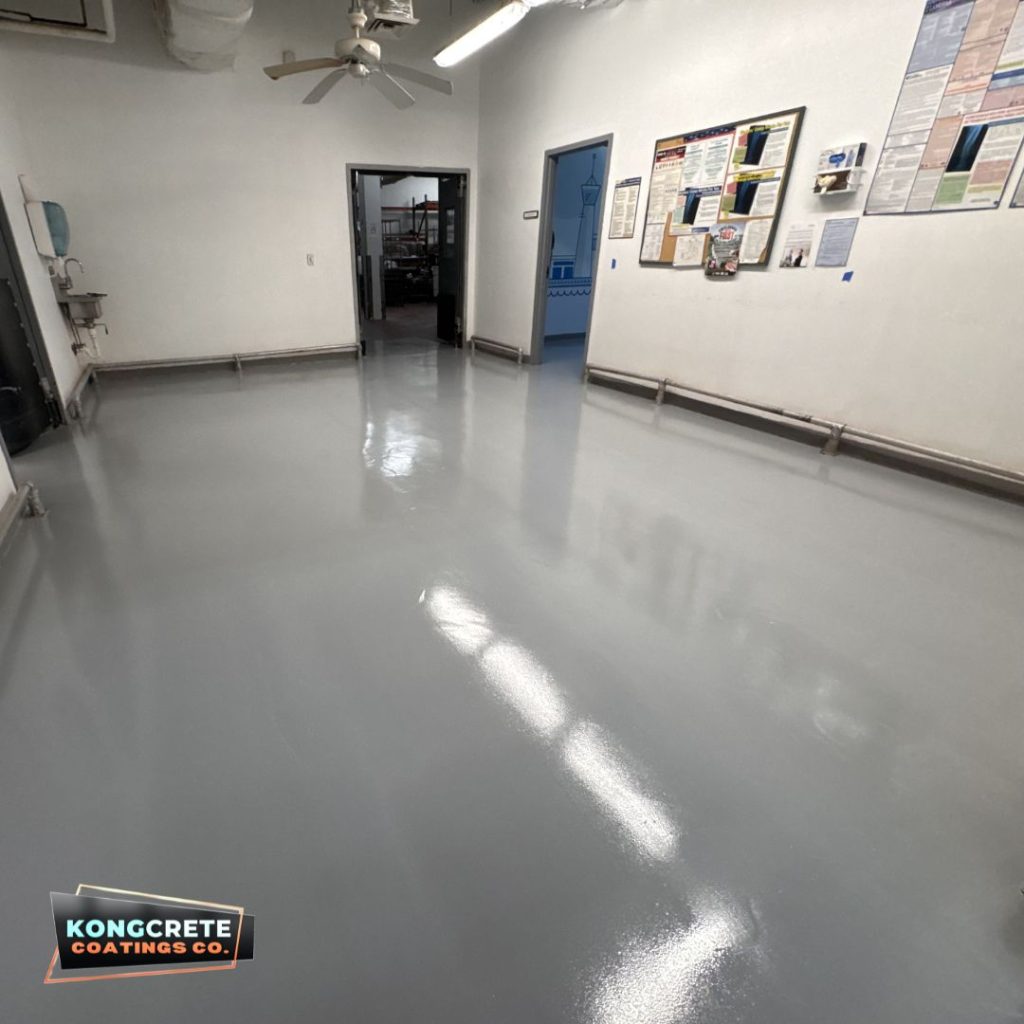
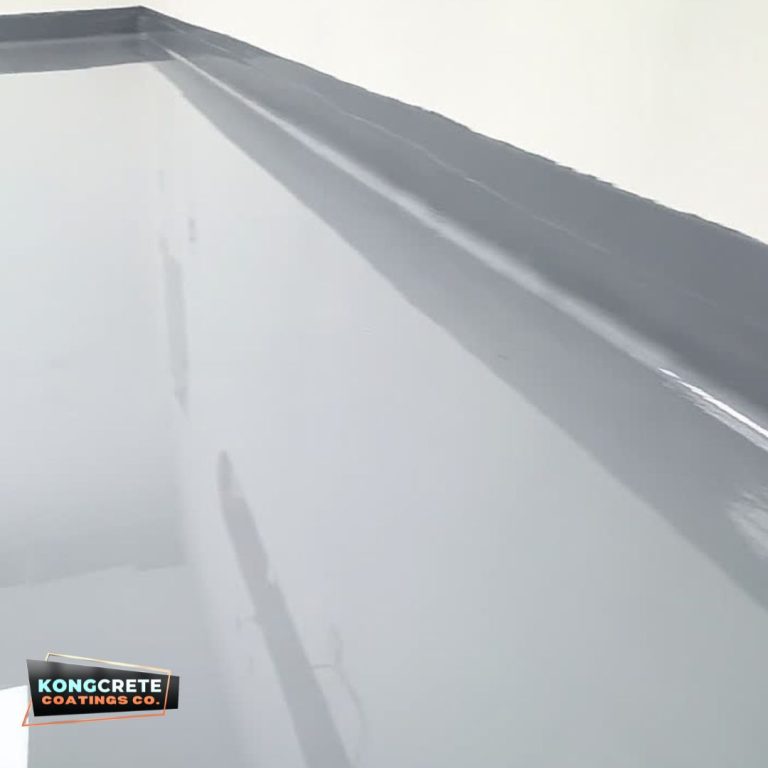
Before applying primary coating layers, our team addressed structural repairs and detailed all floor-to-wall transitions. Perimeter gaps were sealed and beveled to eliminate sharp angles. The coating system was then carried up the perimeter walls to create a continuous coved base detail. Coved bases eliminate 90-degree corners where bacteria, dirt, and water collect, fulfilling DBPR requirements for cleanable, high-moisture transitions.
Step 3: Industrial Moisture Vapor Barrier (MVB)
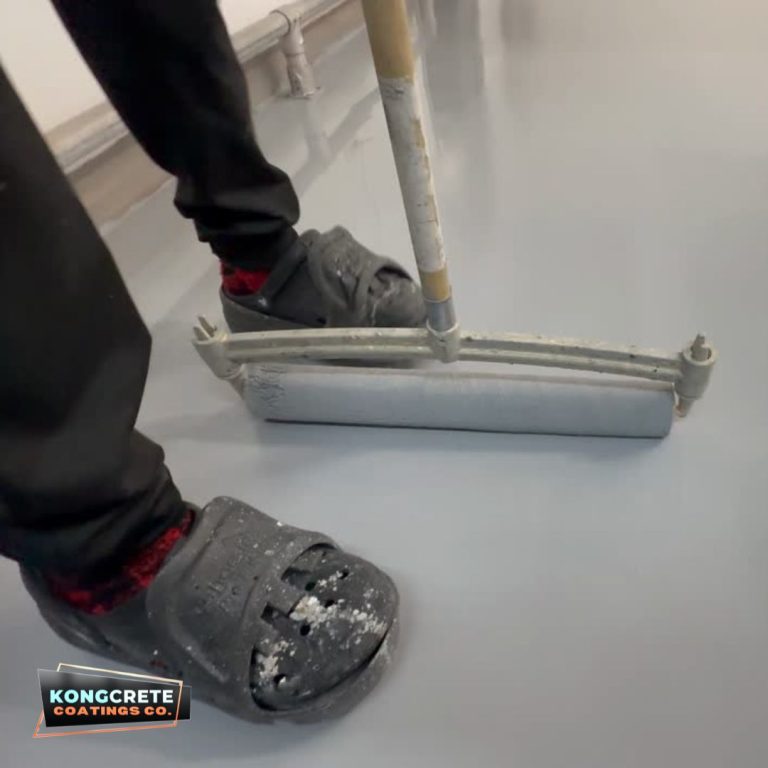
Concrete slabs transmit moisture vapor upward from the soil. In commercial kitchens where ambient moisture is already high, sub-slab moisture vapor transmission can cause floor coatings to blister or fail. Kongcrete applied an industrial moisture vapor barrier (MVB) directly to the prepared concrete. This layer mitigates moisture transmission within published performance tolerances, establishes a uniform foundation, and protects the overlying coating layers.
Step 4: Intermediate Surface Preparation & Dust Control
After the moisture vapor barrier cured, our technicians inspected the surface for imperfections, patched minor air pinholes, and mechanically sanded the floor to prepare it for the base coat. The entire area was vacuumed using commercial HEPA-filtration equipment to eliminate airborne particles and prevent contaminants from being trapped in subsequent layers.
Step 5: Industrial Self-Leveling Epoxy Base Coat
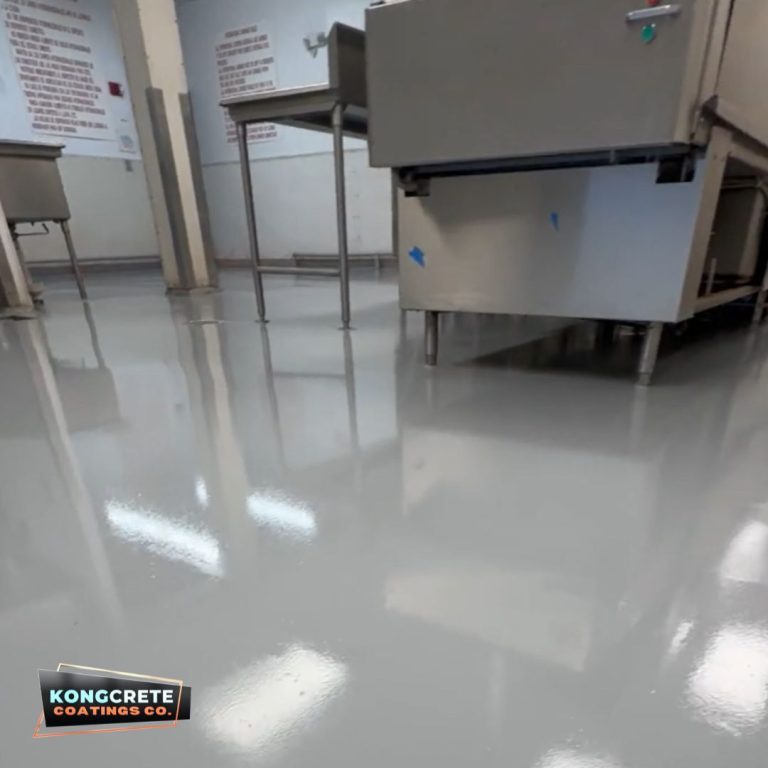
Next, we installed an industrial-grade, self-leveling epoxy coating. This layer forms the primary solid-color body of the floor, creating a seamless, non-porous surface without grout lines. Unlike traditional tile floors—where grout lines trap grease, moisture, and bacteria—a seamless resinous floor provides a smooth, continuous surface that simplifies daily cleaning and meets Florida health code standards.
Step 6: Final Surface Prep Before Protective Topcoat
Before applying the final protective shield, the epoxy surface was once again mechanically prepped and cleaned. Intermediate sanding ensures optimal chemical and mechanical adhesion between the epoxy body coat and the clear protective topcoat according to manufacturer specifications.
Step 7: Industrial Slip-Resistant Highwear Urethane Topcoat
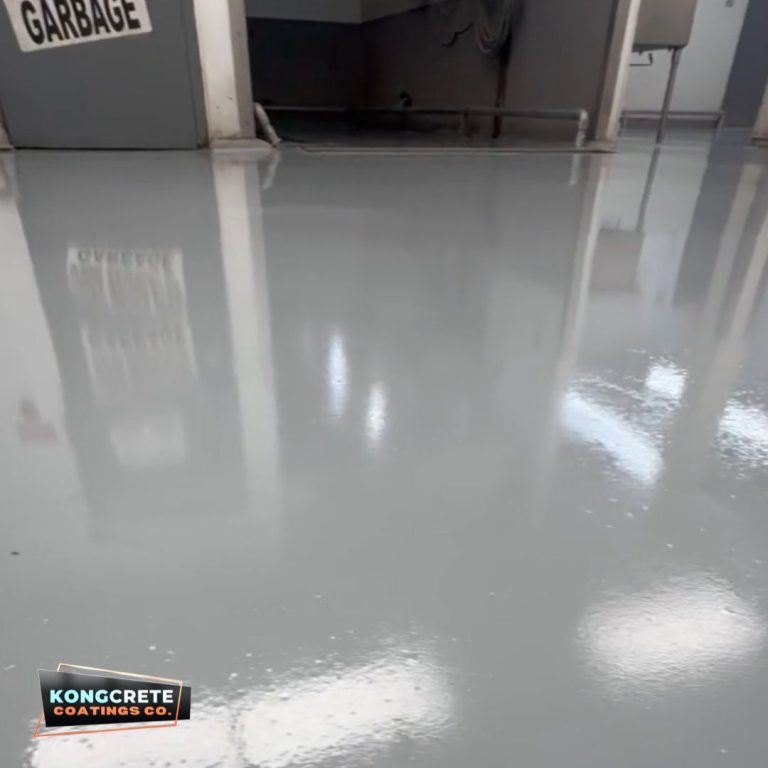
For the ultimate protective layer, Kongcrete installed an industrial/commercial-grade Highwear Urethane topcoat broadcast with an aluminum oxide slip-resistant additive.
Industrial highwear urethanes are specifically engineered for heavy commercial kitchens and high-traffic facilities. They deliver superior advantages over standard finishes:
- Extreme Chemical & Stain Resistance: Highly resistant to hot greases, animal fats, harsh cleaning chemicals, and sanitizers.
- Abrasion & Impact Protection: Exceptional resistance to scuffing, drag marks, and heavy equipment traffic.
- Customized Traction: The addition of aluminum oxide provides crucial slip resistance for wet work areas without creating a surface so rough that it becomes difficult to mop or squeegee.
Why System Design Matters in Commercial Kitchens
One of the biggest misconceptions about commercial resinous flooring is that the coating product itself is the entire solution. The long-term performance of a commercial floor depends on a complete, engineered system:
Customized Solutions for Every Facility
Not all commercial spaces require the exact same floor coating. At Kongcrete Coatings, we evaluate specific operational factors before specifying a system:
- Facility Type & Daily Operations
- Foot and Cart Traffic Intensity
- Chemical and Hot Spill Exposure
- Thermal Shock & Cleaning Methods
- Sub-slab Moisture Conditions
- Regulatory & Health Code Requirements
While a warehouse might prioritize impact resistance, a commercial kitchen requires maximum chemical resistance, highwear urethane protection, and strict sanitary compliance.
Professional Commercial Epoxy & Resinous Flooring in Central Florida
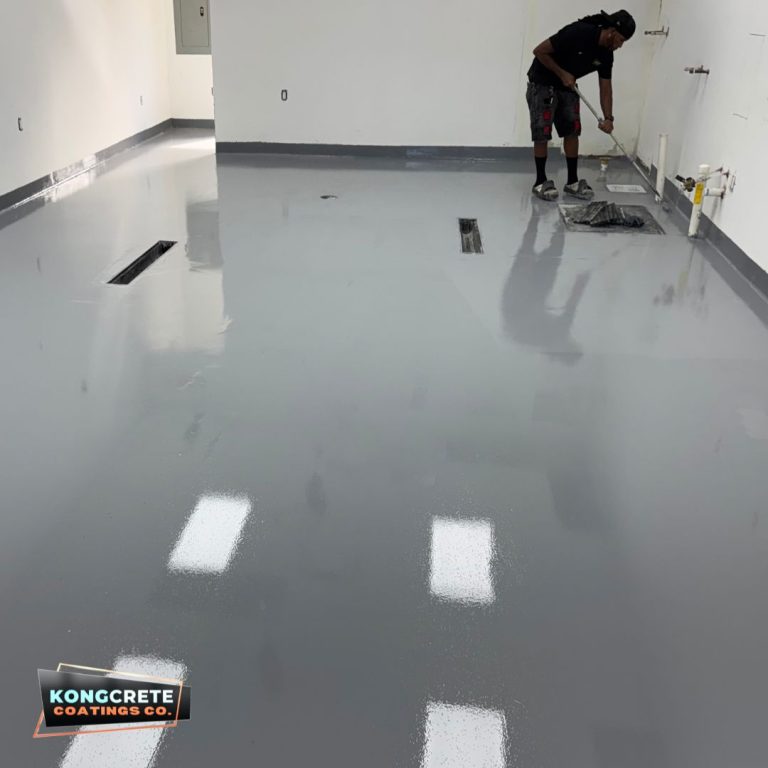
The project at Sanford Orlando International Airport highlights the preparation, precision, and high-performance materials required for a successful commercial kitchen installation.
System Summary:
- Industrial diamond grinding & mechanical prep
- Perimeter repair & DBPR-compliant coved base detail
- Industrial moisture vapor barrier (MVB)
- HEPA-vacuum dust control
- High-build self-leveling epoxy body coat
- Industrial/commercial-grade Highwear Urethane topcoat
- Aluminum oxide slip-resistant texture
Kongcrete Coatings provides commercial epoxy and highwear urethane flooring solutions throughout Sanford, Orlando, and the broader Central Florida area. Whether you are managing a restaurant, airport food facility, school, processing plant, or warehouse, our team engineers resinous flooring systems tailored to your facility’s operational demands.
Planning a Commercial Kitchen Project in Orlando, Sanford, or Surrounding Area?
If you are building out or renovating a food-service facility, ensure your floors are designed for long-term performance from day one. Contact Kongcrete Coatings today to discuss your project requirements or schedule a site evaluation.
Related Commercial Flooring Projects
- Krokem Cookies (Orlando, FL): Solid-color commercial epoxy installation designed for sanitary food production.
- Central Florida School Facility: High-traffic institutional flooring engineered for durability and low maintenance.