Exterior concrete surfaces at automotive dealerships face some of the harshest conditions in the commercial coating industry. Between continuous vehicle traffic, intense UV exposure, heavy rain, motor oil leaks, and hot-tire power steering burn, dealership aprons and entrance walkways demand an ultra-durable, slip-resistant, and weather-proof flooring system.
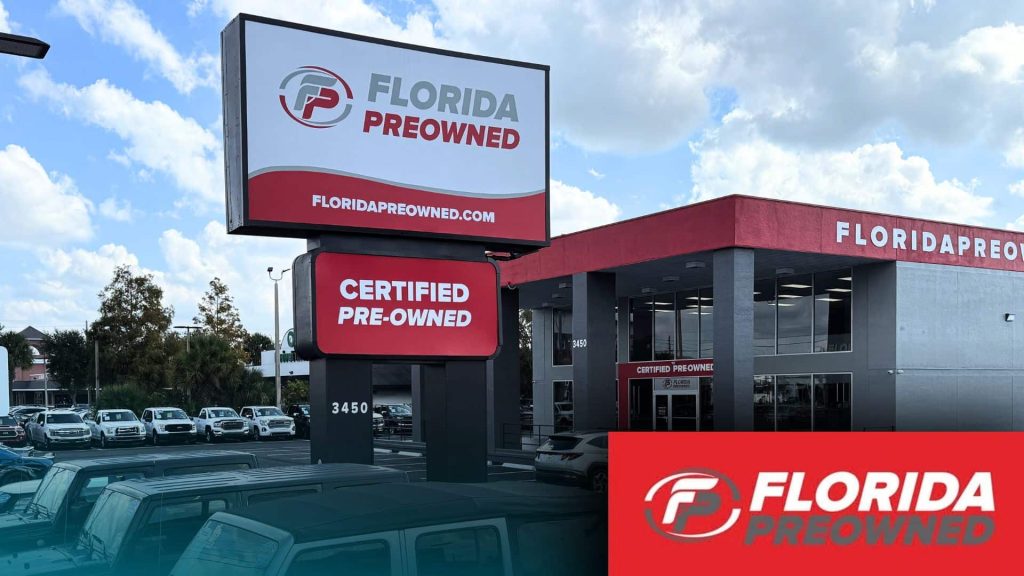
Kongcrete Coatings recently engineered and installed a commercial Polyaspartic Flake Flooring System for Florida Pre-Owned. This case study details how a multi-layer hybrid system provides long-term concrete protection, moisture-resistance, UV stability, and safety for high-traffic commercial automotive properties.

Why Auto Dealership Exteriors Require Specialized Coating
Standard concrete sealers and low-grade coatings quickly yellow, peel, or blister when exposed to Florida’s climate and heavy vehicle traffic. An engineered commercial exterior system must solve four primary challenges:
- UV Degradation: Direct sunlight breaks down standard epoxy resins, causing chalking and yellowing.
- Hot-Tire Pickup: Radial tires retain heat and can pull weak coatings directly off the concrete slab upon power steering turns.
- Chemical & Oil Exposure: Power steering fluids, synthetic oils, and brake fluids dissolve non-industrial coatings.
- Pedestrian Slip Hazards: Rain and vehicle washdowns create slick surfaces on customer walkways and vehicle reception bays.
Step-by-step Exterior Flake System Installation
Step 1: Heavy Mechanical Diamond Grinding & Substrate Profiling
A permanent coating bond requires proper surface preparation.
- Coating Removal: Our installation team utilized Polycrystalline Diamond (PCD) blades to strip away existing thick, failing surface coatings.
- Mechanical Profiling: We profiled the concrete slab using 16-grit diamond blades to achieve an ICRI Concrete Surface Profile (CSP) 2. Opening the concrete pores allowing our industrial vapor moisture barrier base coat to penetrate deep into the concrete slab.
Step 2: High- Performance Polyurea Surface Patching
To ensure a smooth, seamless finish, all cracks, pits, expansion joint edge spalls, and surface gouges were repaired using fast-curing, high-strength commercial polyurea materials.
Step 3: Industrial Debris & Dust Extraction
Airborne dust prevents chemical adhesion. The entire floor underwent industrial concrete mopping and an acetone wash solution to remove remaining micro-dust and surface contaminants.

Step 4: Pigmented Moisture Vapor Barrier & Full Flake Broadcast
A permanent coating bond requires proper surface preparation and a deep penetrating base coat to create a foundational anchor.
- Sub-Slab Moisture Protection: Kongcrete applied an industrial grey Moisture Vapor Barrier (MVB) sealer and base coat at 100 sq. ft. per gallon to block sub-slab moisture vapor transmission. This thicker coating delivers a more durable foundation and gives customers a better feel underfoot.
- 100% Full Flake Broadcast: While the base coat was wet, our crew broadcasts 1/4″ vinyl flakes to complete rejection (100% full coverage). The thick vapor barrier also provides a higher volume of vinyl flake embedment. This means a thicker shield and no patchy or inconsistent areas.
- Cure Time: Our modern moisture vapor barrier technology allows this layer to dry within 2 1/2 hours. Faster dry and cure times means faster turn around time so businesses can open their doors quickly to start or resume operations.

Step 5. Scraping, Top Coat Surface Prep & HEPA Dust Removal.
Next, all excess vinyl flakes were scraped flat to create a comfortable walking texture. The floor was thoroughly cleaned using commercial HEPA-filtration vacuums to eliminate loose aggregate.
Step 6. UV-Stable Industrial Polyaspartic Clear Topcoat
The system was sealed with a clear industrial polyaspartic topcoat. Polyaspartic technology was designed in the 1990’s as an ultimate top coat finish. This delivers key performance advantages for commercial exteriors:
- 100% UV Color Fastness: Will not yellow, fade, or chalk under Florida sunlight.
- Rapid Turnaround: Cures in 2–3 hours, allowing the dealership to resume operations quickly.
- Superior Chemical Resistance: Impervious to motor oil, transmission fluids, and tire plasticizers.
- Integrated Traction: Embedded vinyl aggregate provides a built-in slip-resistant surface for customer foot traffic during heavy rain.
For piers, coastal venues, and commercial kitchens, we recommend additional anti-slip mesh solutions for improved safety and reduced risk and liability. Any space where moisture and water is common can benefit from these solutions.


Technical Project Specifications
|
Specification Feature |
System Detail |
|
Project Location & Type |
Florida Pre-Owned (Exterior Apron & Walkways) |
|
Total Square Footage |
2,200 sq. ft. |
|
Substrate Preparation |
PCD Grind for Epoxy Paint Removal & 16-Grit Diamond Grind (ICRI CSP 2) for MVB Base Coat |
|
Patching Material |
High-Performance Industrial Polyurea |
|
Base / Moisture Coat |
Industrial Hydrostatic Moisture Vapor Barrier (ASTM F3010) |
|
Base/Flake Coverage |
Grey Pigmented Base, 1/4″ Grey/Black Blend Vinyl Flake (100% Coverage) |
|
Protective Topcoat |
Industrial Clear Polyaspartic Coating (High-gloss / Super-flex Technology) |
Frequently Asked Questions
What's the best exterior floor coating for a car dealership?
For a car dealership, the best exterior floor coating is typically a commercial-grade hybrid flooring system built with a Moisture Vapor Barrier (MVB) base coat, full vinyl flake broadcast, and a polyaspartic clear topcoat. This system is well suited for dealership drive lanes, service areas, walkways, customer parking areas, and other high-traffic concrete surfaces exposed to vehicles, weather, chemicals, and UV.
The MVB base coat provides the foundation, creating a strong, deeply anchored layer designed to address moisture-related challenges in concrete. The full vinyl flake broadcast adds texture and coverage, while the polyaspartic clear topcoat provides the protective surface layer, delivering excellent UV stability, abrasion resistance, chemical resistance, and durability.
Polyaspartic is specifically designed to perform as a protective topcoat, where its performance advantages can be fully utilized. Combined with an industrial MVB foundation, this creates a proven, time-tested commercial and industrial floor coating system designed for demanding dealership environments.
Why are polyaspartic coatings preferred over standard epoxy for exterior concrete?
Polyaspartic coatings are preferred over standard epoxy for exterior concrete because they offer superior UV stability, flexibility, thermal shock resistance, and faster cure times. Unlike conventional epoxy, a quality polyaspartic topcoat is designed to withstand prolonged direct sunlight without the yellowing and UV degradation commonly associated with epoxy.
Polyaspartic also has greater elasticity, allowing it to better accommodate the expansion and contraction that exterior concrete experiences with changing temperatures. Its superior thermal shock resistance and rapid cure time make it particularly well suited for demanding outdoor
So you can put polyaspartic coatings outside?
Yes. Polyaspartic coatings are particularly well suited for exterior concrete because they offer excellent UV stability, flexibility, thermal shock resistance, and chemical resistance. Unlike standard epoxy, polyaspartic is designed to function as a durable protective topcoat in environments exposed to sunlight, rain, temperature changes, vehicle traffic, and chemicals.
What is the difference between epoxy and polyaspartic floor coatings?
Epoxy and polyaspartic serve different roles in a high-performance coating system. Epoxy is commonly used as a strong bonding and build layer, while polyaspartic is frequently used as the protective topcoat. Polyaspartic offers advantages for exposed surfaces, including superior UV stability, faster cure times, greater flexibility, and strong resistance to abrasion and chemicals.
How long does a polyaspartic floor coating last outside?
The service life of an exterior polyaspartic floor coating depends on the concrete condition, surface preparation, coating system, traffic, chemical exposure, UV exposure, and maintenance. A properly engineered commercial system with appropriate substrate preparation and a high-quality polyaspartic topcoat can provide long-term performance in demanding exterior environments. The coating system and installation quality are just as important as the individual coating material.

